What Is the Right Order to Learn Video Editing?
Video editing is a set of skills stacked on each other. If you jump to transitions and effects before you can cut a clean sequence, your videos look busy but weak. Here is the order our trainers use with every beginner:
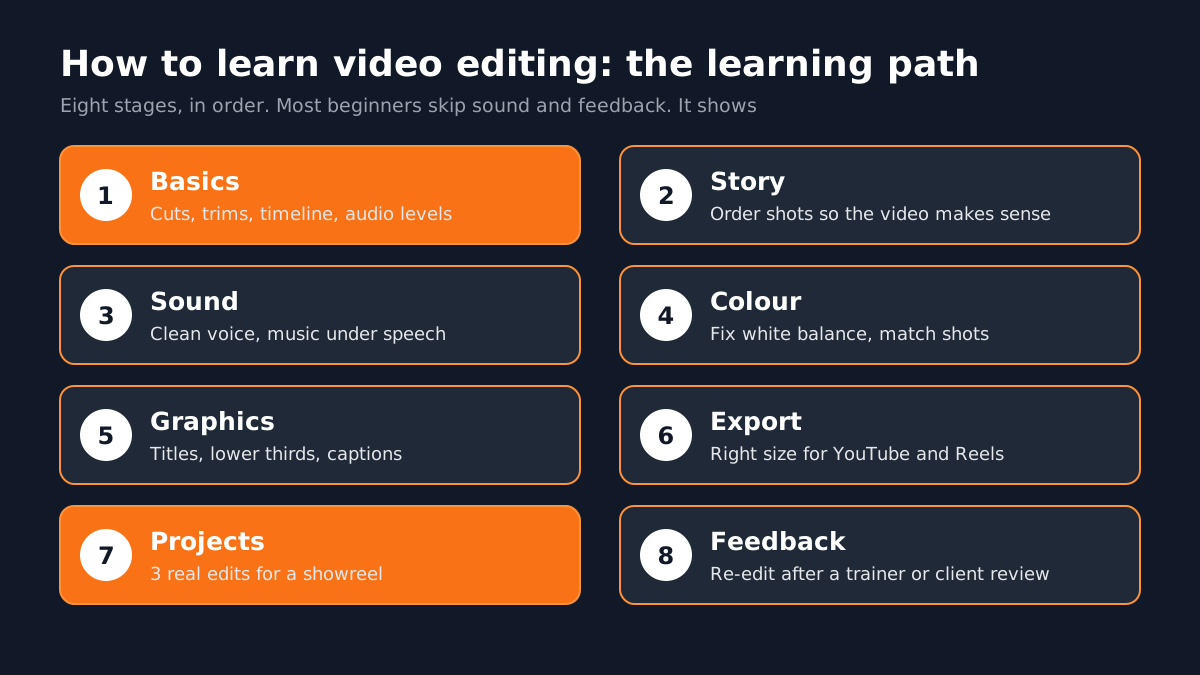
| Stage | What you learn | Rough time with regular practice |
|---|---|---|
| 1. Basics | Importing, the timeline, cuts, trims, audio levels | 2 to 3 weeks |
| 2. Story | Choosing the best shots, order, pacing, cutting on action | 3 to 4 weeks |
| 3. Sound | Clean voice, music under speech, simple sound effects | 2 weeks |
| 4. Colour | White balance, exposure, matching shots | 2 to 3 weeks |
| 5. Graphics | Titles, lower thirds, captions, simple motion | 2 to 3 weeks |
| 6. Export | Right size and format for YouTube, Reels and clients | 1 week |
| 7. Projects | Three full edits for a showreel | 4 to 6 weeks |
| 8. Feedback | Re-editing after a trainer or client review | Ongoing |
If you have never opened editing software, start with our video editing for beginners guide for your very first edit, then come back to this path.
Can You Learn Video Editing on a Phone?
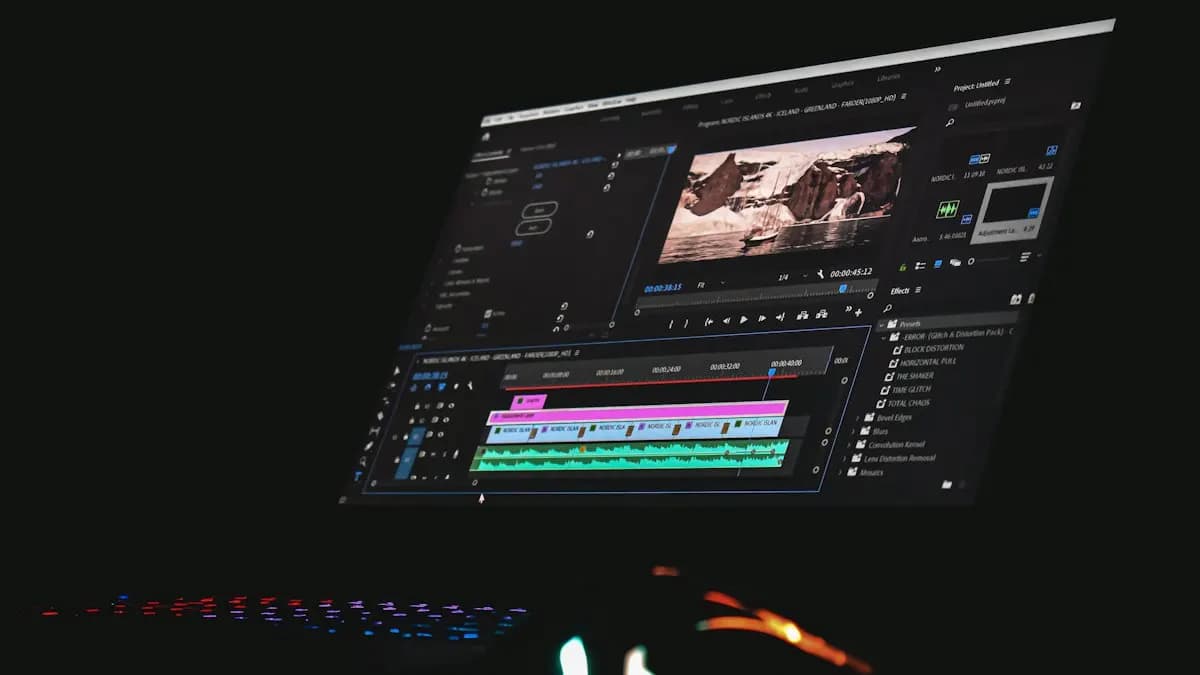
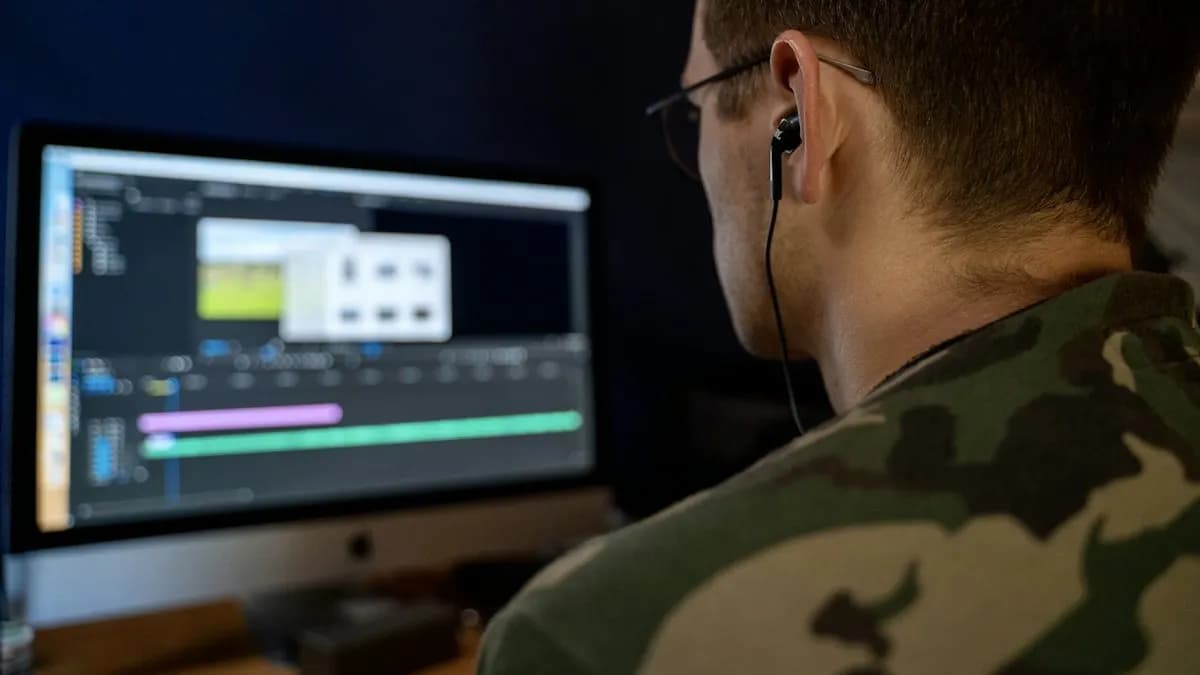
You can shoot on a phone. Many working editors do. But to learn video editing for a job, use a laptop or desktop with professional software. Studios, agencies and YouTube teams work in Premiere Pro, After Effects and similar tools. They expect you to know keyboard shortcuts, project folders and proper exports. Phone apps hide most of this. Our guide on how to shoot on phone and edit on laptop explains the workflow.
What laptop do you need? Adobe's current requirements for Premiere (version 27.0, updated 10 November 2026) list 8 GB of RAM as the minimum for HD editing, with 16 GB recommended for HD and 32 GB or more for 4K. They also list a GPU with at least 4 GB of memory and a fast SSD for the app and cache[1]. Our minimum laptop for video editing guide turns this into a simple buying list.
Where Do You Get Footage to Practise On?
- Your own phone clips: a family function, a market walk, a cooking video. Messy real footage is the best teacher.
- A friend's or relative's small business: a 30-second Reel for a bakery or a gym gives you a real brief.
- Interview practice: record a friend answering five questions, then cut it down to one minute that still makes sense.
- Re-edit an existing video: take a long video you shot and make three versions: 60 seconds, 30 seconds and 15 seconds.
Common Mistakes When Learning Video Editing on Your Own
- Collecting tutorials instead of finishing videos. Set a rule: no new tutorial until the current edit is exported.
- Ignoring sound. Viewers forgive average video, not bad audio. Fix voice levels before anything else.
- Too many transitions and effects. Clean cuts and good pacing look more professional.
- No project folders. Lost media files waste hours. Keep footage, audio, graphics and exports in separate folders from day one.
- No feedback. You cannot see your own pacing problems. Someone else must watch it.
Our Premiere Pro tips for beginners cover settings such as Auto Save and proxies that save beginners from most crashes and lost work.
What Skills Do Employers Expect After You Learn?
We read video job posts for Delhi NCR on Internshala on 14 November 2026. Two examples, in our own words:
- A content team in Delhi wants someone to plan and shoot content in a studio and on location, handle camera, mic, lights and gimbal, then edit the footage in Premiere Pro with an organised file workflow. It asks for at least 1 year of experience[2].
- A manufacturing brand in Ghaziabad wants a videographer who shoots Reels, Shorts and product videos, writes hooks and basic scripts and understands the hook, story, value and call-to-action structure, with 1 to 3 years of experience[3].
Notice two things. File organisation is written into the job. And both posts want editors who understand how a short video holds attention. That is stage 2 (story and pacing) on the learning path, which is why we teach it early.
AI and Agentic AI in Video Editing Work Today
AI tools are now built into editing software, so learn them as part of the path, not as a shortcut around it. In Premiere, Generative Extend (powered by Adobe Firefly) can add up to 2 seconds of video or 10 seconds of audio to the start or end of a clip. It can also fill missing frames for a transition; it needs an internet connection and the AI-made frames are labelled[4]. Editors also use automatic transcription and text-based editing to find quotes fast. Many also use AI assistants such as ChatGPT or Gemini to draft scripts and caption text.
What the editor still decides: which moment tells the story, where to cut, how long to hold a reaction and whether AI-made frames look real. CABA's courses now teach AI and agentic AI workflows inside the curriculum, with the trainer checking each edit before it goes into your showreel.
How Long Until You Can Earn From Video Editing?
With regular practice, most learners can take paid work in about 4 to 6 months; our guide on video editing course duration compares 3, 6 and 10 month options. A typical pay ladder in Delhi NCR:
| Stage | Pay per month (Delhi NCR) |
|---|---|
| First job | ₹12,000 to ₹15,000 |
| After 1 year | ₹18,000 to ₹22,000 |
| After 2 years | ₹30,000 to ₹35,000 |
Learning Alone vs Joining a Video Editing Course
You can learn video editing alone if you are disciplined, but it usually takes longer because nobody tells you why an edit feels slow. A good video editing course gives you the path above, real footage, deadlines and a trainer who reviews every cut. If you want more on what professional training looks like, read learn professional video editing.
Our video editing course in Delhi follows this path one-to-one, with Premiere Pro, After Effects, sound and AI video tools, through client-style projects. It comes with a 100% Job Guarantee; read the job guarantee terms. See the modules and timings on the video editing course page.
Frequently Asked Questions
How can I learn video editing from scratch?
Follow a fixed order: timeline basics, story and pacing, sound, colour, titles and export. Practise on real footage from the first week and finish three full projects with feedback.
How long does it take to learn video editing?
With regular practice, most learners can handle paid work in about 4 to 6 months. Getting really good takes a year or more of real projects.
Can I learn video editing on my phone?
You can shoot on a phone, but for a job you should learn on a laptop with professional software such as Premiere Pro.
Which software should I learn first?
Premiere Pro is a common first choice for editing. After Effects comes later for titles and motion graphics.
Do I need a course to learn video editing?
Not always, but a course with a trainer gives you a clear path, deadlines and feedback, which usually makes learning faster.
References
- Adobe Premiere technical requirements (updated 10 November 2026)- Adobe Help Center
- Cinematographer job in Delhi, Internshala (seen 14 November 2026)- Internshala
- Associate Videographer job in Ghaziabad, Internshala (seen 14 November 2026)- Internshala
- Add frames using Generative Extend in Premiere (updated 10 November 2026)- Adobe Help Center