
What Is Google Ads Performance Max?
Performance Max (often called PMax) is a campaign type in Google Ads. Google describes it as goal-based: one campaign can reach all Google Ads inventory, including YouTube, Display, Search, Discover, Gmail and Maps[1]. It is meant to sit next to your keyword Search campaigns, not replace them.
You provide the goals, budget and creative assets. Google AI then mixes your headlines, images and videos and bids in each auction based on how likely a conversion is. If you are new to the platform, start with our Google Ads course guide to see where PMax fits in the full skill set.
When Should You Use a Performance Max Campaign?
| Situation | Performance Max? | Why |
|---|---|---|
| You track sales or leads properly | Good fit | The AI needs conversion data to learn |
| You want reach beyond Search | Good fit | One campaign covers YouTube, Display, Gmail and more |
| You need tight keyword control | Use Search first | Exact match keywords in Search take priority |
| No conversion tracking yet | Wait | Spend may be limited without tracking |
| Very small test budget | Start with Search | Learning needs enough data to settle |
Google's own setup guide recommends PMax when you have clear conversion goals such as online sales or leads and want access to all of Google's channels in one campaign[2].
How to Set Up a Performance Max Campaign
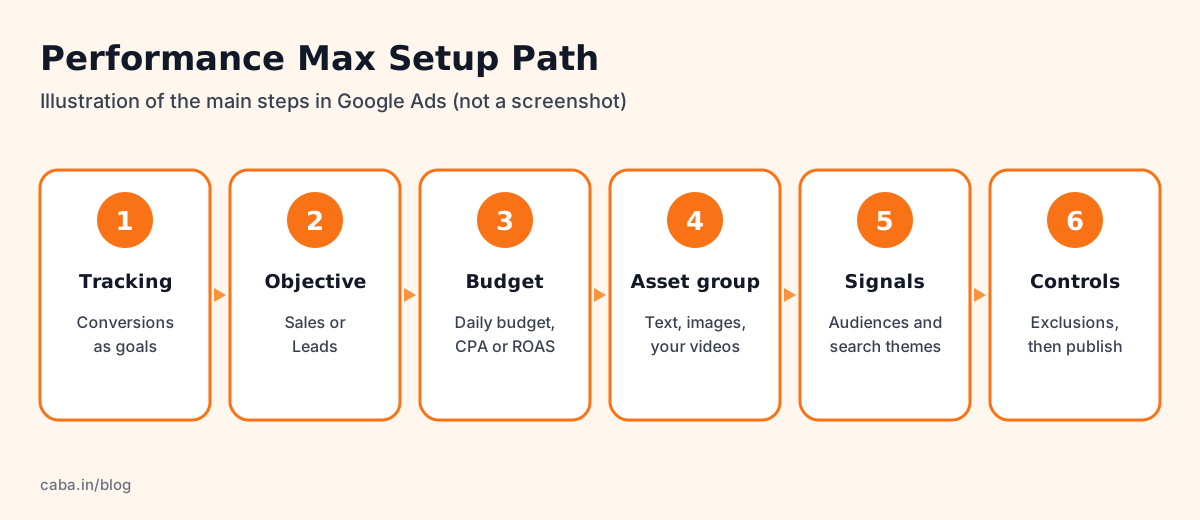
- 1Check conversion tracking
Make sure your key actions, such as form fills or purchases, are tracked and added as campaign goals. See Google Ads conversion tracking.
- 2Choose an objective
In Campaigns, create a new campaign and pick an objective such as Sales or Leads. If Performance Max does not appear, choose to create a campaign without a goal's guidance to see all types[2].
- 3Set budget and bidding
Pick a daily budget and an optional target CPA or ROAS. Avoid targets so tight that the campaign cannot spend.
- 4Build an asset group
Add headlines, descriptions, images, logos and your own videos. Uploaded videos are preferred over auto-generated ones[2].
- 5Add audience signals and search themes
Tell Google who your customers are and which searches matter. Signals guide learning; they do not limit reach.
- 6Set controls and publish
Add brand exclusions, negative keywords and decide on Final URL expansion, then publish and wait for ad review.
Which Performance Max Settings Matter Most?
- Search themes: they carry the same priority as phrase and broad match keywords. Exact match keywords in Search campaigns win when a query matches them[1].
- Brand exclusions and negative keywords: stop PMax from spending on your own brand searches or on queries you do not want.
- Final URL expansion: lets Google send people to a more relevant page on your site and write a matching headline. You remain responsible for checking those pages and texts[1].
- Text customization: Google AI writes extra headlines and descriptions from your landing page and ads. Review them for accuracy.
- Channel prioritization: set priority tiers so you guide where the budget goes, with Search partners and the Display Network as separate tiers[1].
- Brand guidelines: business names and logos are now managed here, so check them before launch[2].
The Learning Phase: Why Patience Matters
Google says campaigns with automated bidding typically need 1 to 2 weeks to learn, sometimes up to 6 weeks. New ads take 1 to 2 days for review and data can take 24 to 48 hours to appear. Frequent or large changes to budget, targets or targeting during this time reset the learning[2].
If a new campaign shows no impressions after 3 business days, Google suggests checking the troubleshooting steps for campaigns that are not running[2]. For other common errors, see Google Ads mistakes to avoid.

Why Performance Max Matters in Digital Marketing Jobs
We read paid-ads job posts on Internshala on 22 November 2026. Two examples, in our own words:
- A Delhi car-care brand hiring a performance marketer wants someone to run Meta Ads, Google Ads and marketplace campaigns, improve ROAS, plan targeting, budgets and creative tests and use AI tools for efficiency. It asks for at least 1 year of experience[3].
- A Mumbai fashion brand hiring a fresher digital marketing executive wants Meta and Google ads run with budget control and a lower cost per customer, plus ad creatives, SEO and festive campaign planning[4].
Both roles judge you on results, not on settings alone. Knowing when to use PMax and when to keep Search separate is exactly the kind of judgement they want. For the wider role, read our performance marketing course guide.
Portfolio Projects for Performance Max
- Asset group audit: take a sample business and write 15 headlines, 5 descriptions, 5 images and one 15-second video brief. Explain why each fits the goal.
- PMax vs Search plan: for a local institute or shop, decide which searches stay in Search with exact match and what PMax should cover. Present it as a one-page plan.
- Learning-phase report: using sample data, write a two-week report that explains what changed and why you did not touch the budget.
Worked example: say a Delhi bakery wants online cake orders. Keep "cake delivery in South Delhi" as exact match in Search. Give PMax the order form as the conversion goal, real cake photos, a short video of decorating and audience signals for past customers. Exclude the bakery's own brand name and review Final URL pages before switching it on.
AI and Agentic AI With Performance Max
PMax itself runs on Google AI for bidding and creative mixing. Google Ads also has Ask Advisor, an agentic assistant built with Gemini that can analyse performance changes, troubleshoot policy issues and suggest text and creatives[1]. Marketers also draft headlines with ChatGPT or Gemini.
The human still sets the goal, the budget limits and the exclusions and checks every AI-written line and landing page for accuracy. CABA's courses now teach AI and agentic AI workflows inside the curriculum.
Why One-to-One Training Helps Here
PMax hides a lot of its working, so beginners often cannot tell whether a problem is tracking, assets or budget. A trainer who looks at your account with you can point to the cause in minutes, which saves weeks of trial and error and real money.
Our digital marketing course in Delhi includes hands-on Google Ads practice alongside Meta Ads, SEO and GA4. Visit the digital marketing course page to see the syllabus.
Frequently Asked Questions
What is a Google Ads Performance Max campaign?
A goal-based campaign type that shows your ads across Search, YouTube, Display, Discover, Gmail and Maps from one campaign, with Google AI choosing placements and bids.
Performance Max vs Search: which is better?
They work together. Search gives tight keyword control and exact match keywords take priority. Performance Max adds reach across all Google channels when conversion tracking is in place.
How long does Performance Max take to learn?
Typically 1 to 2 weeks and sometimes up to 6 weeks. Avoid big changes to budget or targets during this time.
Can I run Performance Max without conversion tracking?
You can create one, but Google says spend may be limited. Set up conversion tracking first.
References
- About Performance Max campaigns- Google Ads Help
- Create a Performance Max campaign- Google Ads Help
- Performance Marketer job in Delhi, Internshala (seen 22 November 2026)- Internshala
- Digital Marketing Executive job in Mumbai, Internshala (seen 22 November 2026)- Internshala